Biblical Archaeology Review Did Yahweh Have a Consort
Asherah and the Asherim: Goddess or Cult Symbol?
Exploring the Biblical and archaeological prove
Ellen White August 03, 2021 41 Comments 78394 views
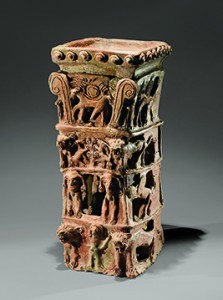
This four-tiered cult stand found at Tanaach is idea to represent Yahweh and Asherah, with each deity existence depicted on alternating tiers. Note that on tier ii, which is dedicated to Asherah, is the prototype of a living tree, ofttimes idea to be how the asherim as a cult symbol was expressed. Photo: © The Israel Museum, Jerusalem/State of israel Antiquities Authority (photo by Avraham Hay).
Who is Asherah? Or, perhaps, what is asherah?1 The Hebrew means "happy" or "upright" and some suggest "(sacred) place." The term appears twoscore times in the Hebrew Bible, usually in conjunction with the definite article "the." The definite article in Hebrew is like to English language in that personal names do not accept an article. For example, I am Ellen, not the Ellen. Thus it is articulate that when the definite article is present that information technology is not a personal name, but this does not eliminate the possibility of information technology beingness a category of existence (i.e., a type of goddess). There are only eight cases where the term appears without an article or a suffix—suffixes in Hebrew can be used to limited possession, east.yard., "his," "their," etc. Interestingly, the plural of the term, asherim, occurs in both masculine and feminine forms.
This diverseness of grammar leads to the 2 questions at the beginning of this article: Who is Asherah? What is asherah? The reference may exist to a particular goddess, a grade of goddess or a cult symbol used to stand for the goddess. It is sometimes hard to distinguish what meaning is intended (cf. Judges 3:7).
This goddess is known from several other Aboriginal Well-nigh Eastern cultures.2 Sometimes she is known every bit "Lady Asherah of the Sea" but could be taken as "She who walks on the sea." As Athirat, a cognate name for Asherah, she is mother of 70 children (this relates to the Jewish thought of the lxx guardian angels of the nations). Arguments have been made that Asherah is a figure in Egyptian, Hittite, Philistine and Arabic texts. Egyptian representations of "Qudshu" (potentially the Egyptian name for Asherah) show her naked with snakes and flowers, sometimes standing on a lion. Whether this should be interpreted as Asherah is contested and thus should exist viewed with circumspection. Another suggestion is Asherah is too the Hittite goddess Asertu, who is married to Elkunirsa, the tempest god (she is often viewed in connection with the regional storm god).
As Athirat in Arabian inscriptions at that place is a possibility that she is seen every bit a sun goddess (this is perhaps a connection in Ugaritic literature besides). In Phoenician, she is the female parent goddess, which is different from Astarte, the fertility goddess; there is some debate regarding a defoliation of the two relating to ane Kings 18:nineteen. In Akkadian, she might be Asratum, the consort of Amurru (chief deity of early Babylon). The connectedness is made considering the Akkadian kingship (early 14th century B.C.Eastward.) takes the title "retainer of Asherah."
The Ugaritic texts provide the most insight into the goddess. Ras Shamra (located on the Syrian declension) texts, discovered in 1929, portray her as Athirat, the wife of El. Their sexual encounter produces dusk (Shalim) and dawn (Shahar), among others. Her human relationship with Baal is complicated, and it is suggested that Baal has killed big numbers of her children.iii In these texts, she intercedes with El to get Baal a palace, after Anat'southward (his "sis" and her "daughter") request is refused. She supplies a son to reign after Baal descends into the netherworld. The relationship is farther complicated past debates as to whether she is the mother of Baal or his consort or both. The idea of her beingness a consort comes from later Phoenician sources, where scholars accept associated Asherah with Tinnit. Yet, the connections are tentative, and many scholars question the association. A hypothesis likewise suggests that Baal usurped El's position and besides took his consort, Asherah, which would make the human relationship very oedipal.
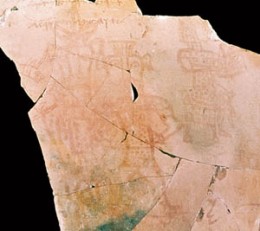
This inscription institute on a pithos at Kuntillet 'Ajrud (similar to an inscription plant at Khirbet el-Qom) refers to "Yahweh and his Asherah." This has led some scholars to believe that in popular religion Asherah was understood to be the married woman of Yahweh, much the same as she under her cognate Athirat was considered to exist the wife of El. Photo: Courtesy Dr. Ze'ev Meshel and Avraham Hai/Tel Aviv University Institute of Archaeology.
Asherah or asherim refer to more than just the person of the deity. These terms are often, especially in the Biblical texts, used for consecrated poles. These poles represent living copse, with which the goddess is associated. Some scholars believe that asherim were not poles, but living copse (like the one depicted on the Tanaach Cult Stand up). The poles were either carved to look like trees or to resemble the goddess (this could also exist reflected in the numerous pillar figurines found throughout State of israel). Remains of these poles are determined past postholes and rotted timber, which resulted in differently hued soil. There is cracking debate equally to whether the cult symbol lost its ties to Asherah (and became a religious symbol on its own without the worshippers knowing anything about the goddess who originated information technology) or is seen as a representation of Asherah herself (similar to the way the cross is a representation of Jesus to Christians).
The relationship between Asherah and Israel is a complicated one.4 Does the text refer to the goddess or her symbol?5 Jeroboam and Rehoboam fostered Asherah worship (1 Kings 14:15, 23). Worship of Asherah was highly encouraged by Jezebel, with the presence of 400 prophets who held a place in the court of her hubby King Ahab (1 Kings eighteen:xix). Worship of Asherah is given as a reason for displacement (2 Kings 17:x,16). Attempts to eradicate the worship were fabricated past Asa, Josiah, Jehoshaphat, Hezekiah and Gideon (Exodus 34:thirteen-fourteen; Deuteronomy 7:five; Judges half dozen:25-30; 1 Kings xv:13/two Chronicles 15:16; 2 Kings 23:4,7/2 Chronicles 34:iii,seven; 2 Kings 21:7/two Chronicles 33:3,19; 2 Chronicles 19:three; ii Kings eighteen:four). However, devotion to the cult symbol remained (Isaiah 27:9; Jeremiah 17:ane; Micah 5:xiv). It is particularly interesting that objections to Asherah are found mostly in Deuteronomistic literature, rather than in the prophets. In both cases, the authors are much more concerned about the worship of Baal rather than Asherah.
Go a Fellow member of Biblical Archaeology Society Now and Get More Than One-half Off the Regular Price of the All-Access Pass!
Explore the world'due south well-nigh intriguing Biblical scholarship
Dig into more than 9,000 articles in the Biblical Archæology Society'due south vast library plus much more with an All-Access pass.

This apparent lack of business might be due to a popular connexion betwixt Yahweh and his Asherah. Inscriptions from Kuntillet 'Ajrud (on a pithos; see image above) and Khirbet el-Qom (on walls) incorporate the phrase "Yahweh and his Asherah."6 Some take this to hateful information technology was believed that she was seen as the wife of Yahweh and represents the goddess herself. Nonetheless, the presence of the suffix could suggest that it is not a personal name. This has led others to believe it is a reference to the cult symbol. A more obscure opinion claims it ways a cella or chapel; this meaning is establish in other Semitic languages, just not Hebrew. Considering of the similarities between El and Yahweh, it is understandable that Asherah could take been linked to Yahweh. While some readers might observe the idea that Yahweh had a married woman disturbing, it was mutual in the ancient world to believe that gods married and even bore children. This popular connectedness between Yahweh and Asherah, and the eventual purging of Asherah from the Israelite cult, is likely a reflection of the emergence of monotheism from the Israelites' previous polytheistic worldview.
 Ellen White, Ph.D. (Hebrew Bible, University of St. Michael's College), formerly the senior editor at the Biblical Archæology Society, has taught at five universities across the U.S. and Canada and spent research leaves in Deutschland and Romania. She has as well been actively involved in digs at various sites in Israel.
Notes:
1. Ane of the most influential studies on Asherah is Saul M. Olyan, Asherah and the Cult of Yahweh in Israel, Society of Biblical Literature Monograph Serial (Atlanta: Scholars Press, 1988). Olyan's written report provides groundwork for this piece.
ii. For a detailed written report of Asherah exterior of the Biblical texts, meet Walter A. Maier, Asherah: Extrabiblical Bear witness, Harvard Semitic Monographs (Atlanta: Scholars Press, 1986).
3. Olyan, Asherah, pp. 38–61.
4. For one of the best treatment of Asherah and Israel, see Judith M. Hadley, The Cult of Asherah in Ancient State of israel and Judah: Evidence for a Hebrew Goddess, Academy of Cambridge Oriental Publications (Cambridge: Cambridge University Press, 2000).
five. For a really proficient analysis of the Biblical passages involving Asherah, encounter C. Frevel, Aschera und der Ausschliesslichkeitsanspruch YHWHs, Bonner biblische Beitrage (Weinheim: Belz Athenaum Verlag, 1995).
half dozen. For more details, run across William Dever, Did God Have a Wife? Archaeology and Folk Religion in Ancient Israel (1000 Rapids: Eerdmans, 2005), pp. 176–251.
Visit the BAS Library for more on Asherah:
Shmuel Ahituv, "Did God Have a Wife?" Biblical Archeology Review, September/October 2006.
Ephraim Stern, "Pagan Yahwism: The Folk Religion of Ancient Israel," Biblical Archæology Review, May/June 2001.
William G. Dever, "Folk Religion in Early State of israel: Did Yahweh Have a Consort?" in Hershel Shanks and Jack Meinhardt, eds., Aspects of Monotheism (Washington, DC: Biblical Archaeology Club, 1996), pp. 27–56, 127–129.
J. Glen Taylor, "Was Yahweh Worshiped every bit the Sun?" Biblical Archaeology Review, May/June 1994.
Ruth Hestrin, "Understanding Asherah—Exploring Semitic Iconography," Biblical Archaeology Review, September/October 1991.
André Lemaire, "Who or What Was Yahweh's Asherah?" Biblical Archeology Review, November/Dec 1984.
Ze'ev Meshel, "Did Yahweh Have a Espoused?" Biblical Archeology Review, March/April 1979.
Not a BAS Library member nonetheless? Bring together the BAS Library today.
Related reading in Bible History Daily:
Puzzling Finds from Kuntillet 'Ajrud
High Places, Altars and the Bamah
Judean Colonnade Figurines
How Bad Was Jezebel?
This Bible History Daily feature was originally published on November 4, 2014.
Source: https://www.biblicalarchaeology.org/daily/ancient-cultures/ancient-israel/asherah-and-the-asherim-goddess-or-cult-symbol/

Post a Comment for "Biblical Archaeology Review Did Yahweh Have a Consort"