The Textbased Art of Barbara Kruger Is an Example of
/https://tf-cmsv2-smithsonianmag-media.s3.amazonaws.com/filer/Profile-Barbara-Kruger-631.jpg)
Barbara Kruger is heading to Washington bearing the single word that has the ability to milkshake the seat of authorities to its roots and cleave its sclerotic, deep-frozen deadlock.
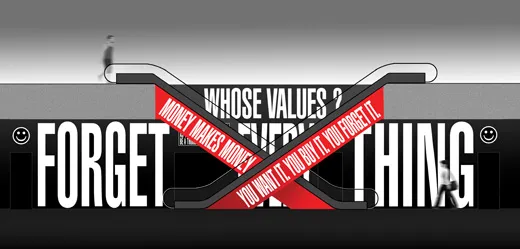
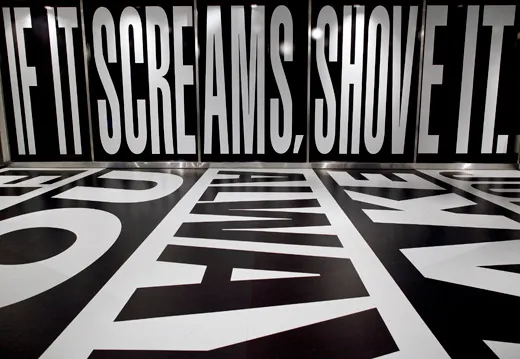
What is the discussion? Well, beginning let me introduce Barbara Kruger. If you don't know her name, yous've probably seen her work in fine art galleries, on magazine covers or in giant installations that comprehend walls, billboards, buildings, buses, trains and tram lines all over the world. Her new installation at the Hirshhorn Museum in Washington, D.C., scheduled to open August 20—the 1 that focuses on that powerful, power-zapping discussion (yep, I will tell yous what it is)—volition exist visible from two floors of public infinite, filling the unabridged lower vestibule area, besides roofing the sides and undersides of the escalators. And when I say floors, I mean that literally. Visitors will walk upon her words, exist surrounded by walls of her words, ride on escalators covered with her words.
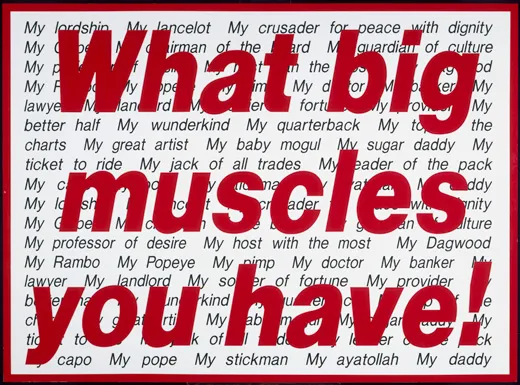
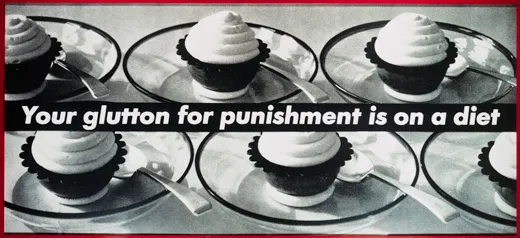
What'southward the best way to depict her work? You know abstruse expressionism, correct? Well, think of Kruger'southward art as "extract expressionism." She takes images from the mass media and pastes words over them, big, bold extracts of text—aphorisms, questions, slogans. Short machine-gun bursts of words that when isolated, and framed past Kruger's gaze, linger in your mind, forcing you to remember twice, thrice about clichés and catchphrases, introducing ironies into cultural idioms and the conventional wisdom they embed in our brains.
A woman's face up in a mirror shattered by a bullet hole, a mirror on which the phrase "You are non yourself" is superimposed to destabilize us, at least momentarily. (Not myself! Who am I?) Her aphorisms range from the overtly political (Your torso is a battleground) to the culturally acidic (Charisma is the perfume of your gods) to the challengingly metaphysical (Who do you recollect yous are?).
Kruger grew upwards middle class in Newark, New Jersey, and her commencement job was equally a page designer at Mademoiselle. She turned out to be a master at using blazon seductively to frame and foreground the image and lure the reader to the text.
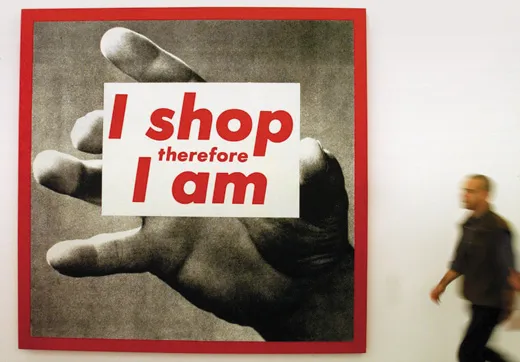
The dream-machine magazine empire of Condé Nast (which also publishes Faddy, Vanity Fair and Glamour)—the dizzyingly seductive and powerful fusion of manner, class, coin, image and status—represented both an inspiration and an inviting target. The fantasy-fueled appetite to consume became Kruger'due south enduring subject when she left for the downtown art world, where many of her early pieces were formal verbal defacements of glossy magazine pages, glamorous graffiti. One of her most famous works proclaimed, "I shop therefore I am."
Kruger keeps her finger tightly pressed to the pulse of popular culture. So it shouldn't have surprised me as much every bit it did when, in the middle of a recent lunch at the Los Angeles Canton Museum of Art, she practically leapt out of her chair and pointed excitedly to someone on the plaza outside. "It'southward the hairdresser from Bravo!" she exclaimed excitedly. When I professed ignorance, Kruger explained, "She's on this Bravo reality series where she goes into failing pilus salons and fixes them up." (I later learned the woman was Tabatha, from a evidence called "Tabatha Takes Over.")
In addition to existence a self-proclaimed "news junkie" and bookmarking the Guardian and other such serious sites, Kruger is a big educatee of reality shows, she told me. Which makes sense in a fashion: Her piece of work is all about skewed representations of reality. How we pose as ourselves. She discoursed knowingly about current trends in reality shows, including the "preppers" (preparing for the apocalypse) and the storage wars and the hoarder shows. Those shows, she thinks, tell us important things about value, materialism and consumerism.
Kruger has immersed herself in such abstract thinkers as Walter Benjamin, the prewar post-modernist ("Did you know he was a compulsive shopper? Read his Moscow Diary!"), and Pierre Bourdieu, the influential postmodern French intellectual responsible for the concept of "cultural capital" (the idea that status, "prestige" and media recognition count equally much as money when it comes to assessing power). Only she knows theory is not enough. She needs to wade into the muddy river of American culture, panning for iconic words and images like a miner looking for gold in a fast-running stream, extracting the nuggets and giving them a setting and a polish so they tin serve as our mirror.
Christopher Ricks, a one-time Oxford professor of poetry, one time told me the simplest way to recognize value in fine art: It is "that which continues to repay attention." And Barbara Kruger'south words not but repay simply demand attention from us. Her work has become more relevant than ever at a time when we are inundated by words in a boundless, delirious way—by the torrent, the tidal wave, the tsunami unleashed by the Internet. "What practise you read, my lord?" Polonius asks Village. "Words, words, words," he replies. Meaningless words. And that is what they threaten to get as we drown in oceans of text on the web. Pixels, pixels, pixels.
In a virtual world, virtual words are becoming virtually weightless, dematerialized. The more than words wash over united states, the less we empathise them. And the less we are able to recognize which ones are influencing us—manipulating us subtly, invisibly, insidiously. Barbara Kruger rematerializes words, then that we can read them closely, deeply.
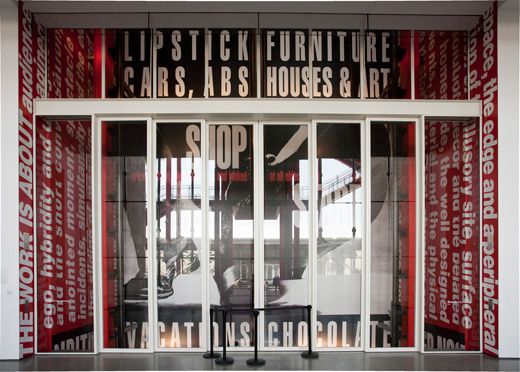
I arrived early for our lunch at LACMA considering I wanted to see the installation she'd washed there, roofing a massive three-story glassed-in garage elevator with an extraordinary profusion of words and phrases. Among these words and phrases is a long, eloquent description of the piece of work itself:
"The piece of work is about...audience and the scrutiny of judgment...way and the imperialism of garments, community and the soapbox of self-esteem, witnessing and the all-powerful moment, spectacle and the enveloped viewer, narrative and the gathering of incidents, simultaneity and the elusive now, digitals and the rush of the capture." At that place's much, much more than just in case we miss whatever aspect of what "the work is well-nigh." Indeed the work is in role nearly a work telling itself what information technology's almost.
Detect how much of it is about extraction: extraction of "the anointed moment" from the stream of time (and stream of consciousness), finding a way to crystallize the "elusive now" amongst the rush of "digitals." Information technology's the Kruger of all Krugers.
But gazing at this, I missed the single most important extraction—or at least its origin. The elephant in the installation.
It was up in that location, dominating the top of the piece of work, a line written in the biggest, boldest, baddest letters. The cardinal stack of words is superimposed over the brooding eyes and the advancing shoes of a man in what looks similar a black-and-white pic still. His head is exploding into what looks like a bare white mushroom cloud, and on the deject is written: "If yous want a motion picture of the futurity, imagine a boot stomping on a human face forever."
Accept a nice day, museumgoers!
Not long after, I was seated in LACMA's sleek restaurant with Kruger, whose waterfalls of fragile curls give her a pre-Raphaelite, Laurel Canyon wait. (She lives half the year in 50.A. teaching at UCLA, one-half the year in New York Urban center.) 1 of the first things I asked about was that kicking-stomping line on the elevator installation. "I was glad to see someone every bit pessimistic as me well-nigh the future. Where'd you get that quote?"
"It's George Orwell," she replied. Orwell, of course! It's been a long time since I've read 1984, so I'm grateful that she extracted it, this unmediated prophecy of doom from someone whose pronouncements have, uncannily and tragically, kept coming truthful. And it reminded me that she shares with Orwell an oracular mode of thought—and a preoccupation with language. Orwell invented Newspeak, words refashioned to become lies. Kruger works similarly, but in the opposite direction. Truespeak? Kru-speak?
"Unfortunately," she went on to remark ominously of the Orwell quote, "it'south still very viable."
For some, Kruger has had a forbidding aura, which is probably because of the stringent feminist content of some of her more agitprop aphorisms, such every bit "Your body is a battleground," which features a woman's face up made into a grotesque-looking mask past slicing it in half and rendering one side as a negative. When I afterwards told people I'd plant Kruger down-to-globe, humorous and even kindly, those who knew her readily agreed, those who knew only her early on work were a bit surprised.
But she's made a bespeak of being more than an ideologue. "I always say I try to make my piece of work about how we are to one another," she told me.
That reminded me of one of her works in which the word "empathy" stood out.
"'How we are to each other,'" I asked. "Is that how you lot define empathy?"
"Oh," she replied with a express joy, "well, too often it'southward non [how we are to each other]."
"But ideally...we're empathetic?"
"No," she said, "I don't know if that'south been wired into u.s.. Simply I mean I've never been engaged with the war of the sexes. It's too binary. The good versus the bad. Who's the good?"
It'due south a phrase she uses frequently: "besides binary." She'd rather piece of work in multiple shades of meaning and the ironies that undercut them.
All of which brings usa to her upcoming installation invasion of Washington and that potent, verboten word she wants to bring to Washington'due south attending. The magic word with the secret power that is similar garlic to Dracula in a town full of partisans. The word is "DOUBT."
"I'd only been in Washington a few times, mainly for antiwar marches and pro-selection rallies," she said. "Just I'm interested in notions of power and command and love and coin and death and pleasure and pain. And Richard [Koshalek, the director of the Hirshhorn] wanted me to exercise candor without trying to exist ridiculously...I recollect I sometimes run across things that are provocative for provocations' sake." (A rare access for an artist—self-doubt.) "And so I'one thousand looking forward to bringing up these issues of belief, power and doubt."
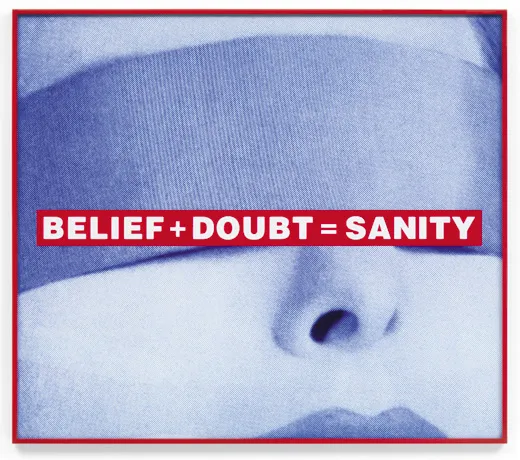
The official title she'due south given her installation is Belief+Doubt. In an earlier work (pictured below), she had used the phrase Conventionalities+Doubt=Sanity.
I asked her what had happened to "sanity." Had she given up on information technology?
"You lot tin say 'clarity,' you can say 'wisdom,'" she replied, merely if you look at the equation closely, adding uncertainty to conventionalities is really subtracting something from belief: blind certainty.
The conversation about incertitude turned to agnosticism, the ultimate doubt.
She made clear there'southward an important distinction between beingness an atheist and being an agnostic, as she is: Atheists don't doubt! "Atheists have the ferociousness of true believers—which sort of undermines their position!" she said.
"In this country," she added, "it's easier to exist a pedophile than an agnostic."
Both sides—believer and atheist—depend on certainty to agree themselves together. A dynamic that as well might explain the deadlock in politics in Washington: both sides refusing to admit the slightest uncertainty nigh their position, about their values, near the claim to have all the answers.
"Whose values?" is the Kruger extraction at the very summit of her Hirshhorn installation—and its about destructive question. With the absenteeism of dubiety, each side clings to its values, devaluing the other side's values, making whatever cooperation an act of betrayal.
"Everybody makes this values claim," she pointed out, "that their values are the only values. Doubt is about grounds for arrest—and nosotros're even so perilously close to that in many ways, you know."
And so in its way the Hirshhorn installation may turn out to be genuinely subversive. Introducing doubtfulness into polarized D.C. political culture could be similar letting loose a mutation of the swine flu virus.
Let'due south hope information technology'due south contagious.

/https://tf-cmsv2-smithsonianmag-media.s3.amazonaws.com/filer/Profile-Barbara-Kruger-631.jpg&description=The Textbased Art of Barbara Kruger Is an Example of)
Post a Comment for "The Textbased Art of Barbara Kruger Is an Example of"